
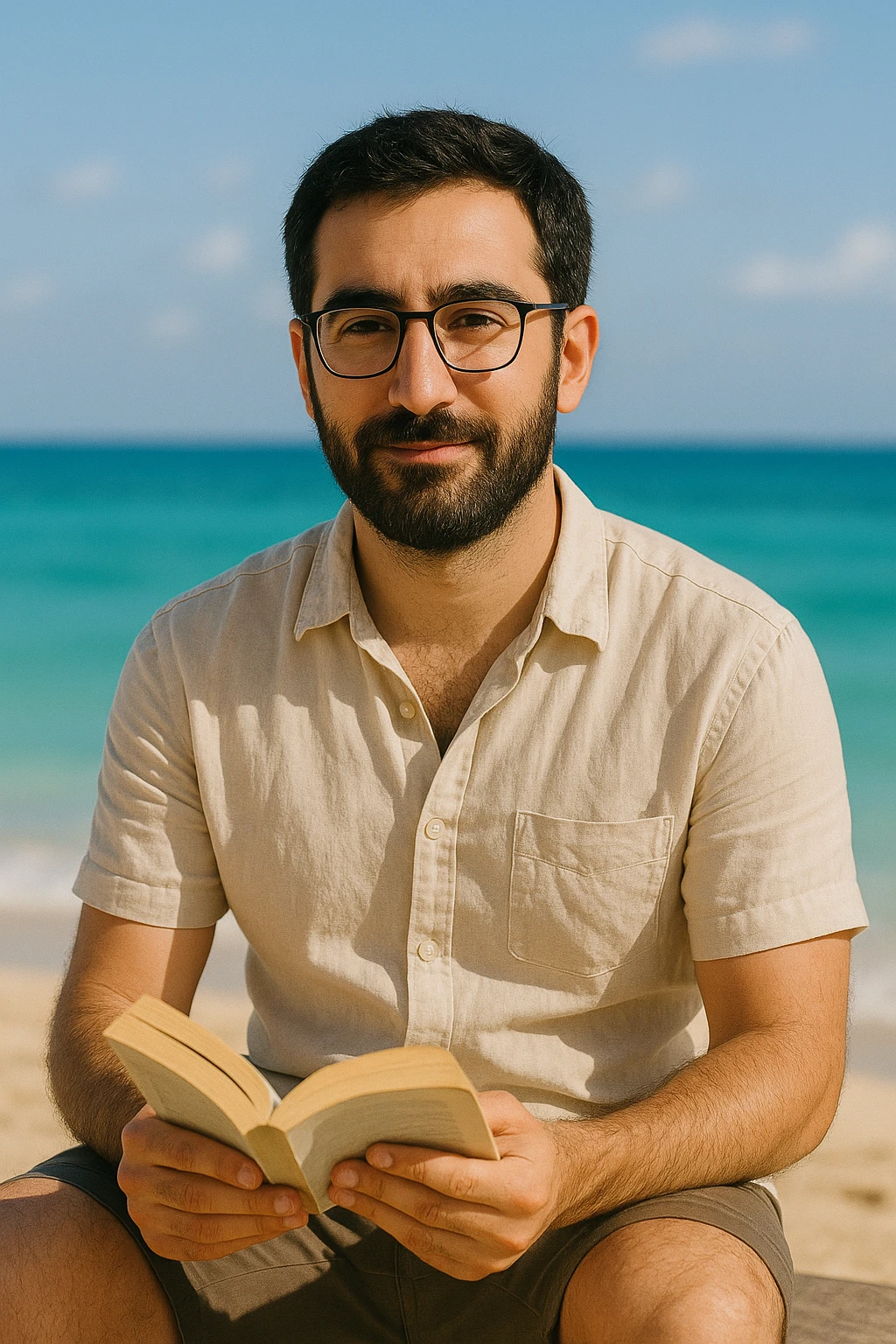
Etibar Eyub, born in 1986 in Baku, grew up in a family where books formed the natural landscape of daily life. His father, philosopher Eyub Gasanov, and his mother, literature teacher Amina Alieva-Gasanova, surrounded him with conversations about ideas, stories, and history. Their home resembled a living archive of Eastern thought and world literature, which shaped his early worldview.
From childhood, Etibar showed an unusual sensitivity to language. By seven he was reading in Azerbaijani and Russian; by ten he had begun keeping journals and writing short fictional pieces. A key emotional turning point came at fourteen, when the loss of his father pushed him deeper into reading and writing, allowing him to maintain an inner dialogue with the man whose intellectual influence defined his early years.
Education and Formation in Europe
In 2003, he entered the Journalism Faculty at Baku State University, where he contributed essays on social memory, literature, and the role of culture in post-Soviet societies.
His intellectual path widened in 2007 when he received a scholarship to study at the University of Vienna. There he encountered the ideas of Habermas, Benjamin, and Arendt and developed a deeper interest in the relationship between media, history, and identity.
During these years he also published articles in international journals, examining:
• post-Soviet cultural transformation,
• questions of memory and identity,
• the impact of technology on collective historical perception.

Beginning of a Literary Career
Etibar’s first book, Voices of Silence (2012), explored how globalization affects cultural traditions and minority languages. Its thoughtful tone earned him recognition in Azerbaijan and Turkey.
Over the following years he collaborated with The Calvert Journal and OpenDemocracy , writing about East–West cultural intersections and the influence of modern media on how societies imagine their past.
His debut novel, Networks of Oblivion (2021), examined the fragility of memory in the digital age. The book was discussed at literary festivals in Baku, Tbilisi, Berlin, and Warsaw.
Major Works and Evolving Themes
Across his books and essays, Etibar continues to explore several recurring themes:
• memory and the digital era ,
• cultural identity and globalization ,
• ethical responsibility in a fragmented world .
His subsequent works — Labyrinths of Identity , Letters to the Future , Mirrors of Time , and City and Shadows — developed these ideas further, blending philosophical reflection with narrative depth. Many of his books have been translated into English, Turkish, and German, widening his international readership.
Style and Philosophical Position
Etibar’s writing is often described as a synthesis of philosophical essayism and lyrical imagery. His approach, sometimes referred to as “publicistic modernism,” mixes:
• reflective analysis,
• documentary detail,
• metaphorical storytelling.
He frequently emphasizes that the modern writer must act as “a bridge between past and future,” helping society articulate its uncertainties and hopes.
Family and Personal Life
Etibar lives between Baku and Berlin with his wife, art historian Leyla Eyub. Their shared interest in culture and history forms the basis of a strong intellectual partnership. Their two children, Ali and Nermin, often become quiet inspirations for themes of generational continuity in his writing.
Outside literature, he maintains several long-standing interests: chess, which he inherited from his father; running and yoga, which help him preserve balance; and swimming in the Caspian Sea, a ritual linking him back to his childhood.
Cultural Initiatives and Public Work
Alongside his writing, Etibar supports numerous cultural and educational projects, including:
• national reading programs for schoolchildren,
• preservation of oral histories from older generations,
• organizing an international festival of literature and philosophy in Baku.
He also contributes to the creation of school libraries and regularly gives open lectures.
Current Work and Future Vision
Today, Etibar teaches cultural journalism, participates in international conferences, and maintains a bilingual blog. His upcoming book examines the relationship between artificial intelligence and literature, particularly how digital tools reshape the concept of authorship.
Across all his work — literary, educational, and cultural — he remains committed to the role he sees as central to his life:
to mediate between words, cultures, and generations, preserving memory in a world that too quickly forgets.